Transportation
1
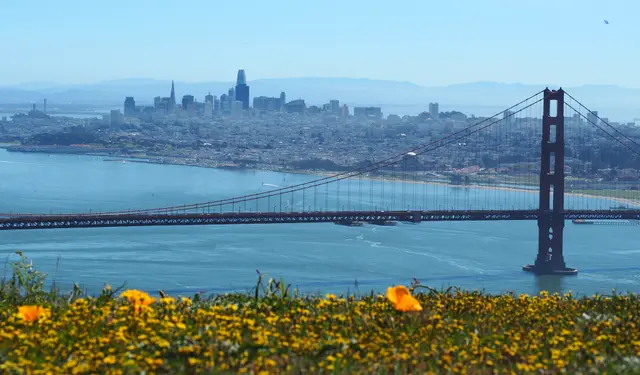
Until 10,000 years ago, sea level was more than 300 feet lower than today, and an ancient river cut a canyon here that became the Golden Gate Strait. As a warmer climate ended the Ice Age, rising seas flooded the interior valley to form San Francisco Bay, which connects to the Pacific Ocean through the strait, and sixty percent of California's rain and snow still drains through this gap in the coastal mountains of Northern California. Strong tides, frequent winds, fog, salt air, and the nearby San Andreas Fault, only 7 miles offshore, made bridging the strait especially difficult. Native people living along San Francisco Bay witnessed the first recorded European exploration here in 1775, when the Spanish ship San Carlos sailed through the Golden Gate, and in 1776 Spain established Yerba Buena, later renamed San Francisco. The city's population grew from fewer than 500 in 1848 to ten times that in 1849 during the Gold Rush, and soon after 1900 the San Francisco Bay Region had reached a million people. As California's major north-south Highway 101 needed a crossing to complete a statewide transportation route, a bridge over the Golden Gate Strait would have to achieve the longest span in the world. Advances in civil engineering in the early twentieth century turned that once impossible vision into a difficult but achievable project, and despite political opposition and scarce funding during the Great Depression, civic leaders, engineers, and construction workers joined to design and build what had been considered the bridge that could not be built.
Hear stories like this as you drive
ExploreHere reads historical markers out loud as you pass them: over 325,000 stories across the US. No account needed.
4.7 · 800+ ratings · Free
FIND IT
San Francisco, California · United States