Military
5
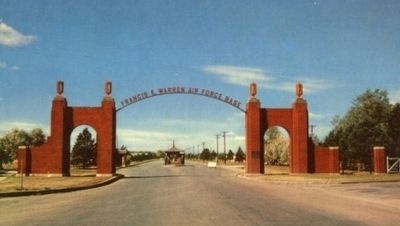
In 1949, Fort Warren and the City of Cheyenne joined forces to fight the Blizzard of 49, with personnel and equipment from the 3450th Technical Training Wing clearing the city airport and the Veterans Hospital, plowing roads for Laramie County, and delivering medical supplies and fuel. The blizzards led to Operation Snowbound, a Presidential Proclamation that provided relief for snowbound families and livestock in southeastern Wyoming. Fort personnel using bulldozers, graders, military vehicles, and snow plows cleared about 1,700 miles of roads to reach more than 1,000 residents and 106,000 stranded livestock, expending an estimated 70,179 man hours. On July 7, 1949, Fort Warren was assigned to the newly emerging U.S. Air Force and renamed Francis E. Warren Air Force Base. By 1957, the base had become the nation’s first operational Intercontinental Ballistic Missile unit and was assigned 24 Atlas missiles, a liquid-fueled, radio controlled system placed in above-ground silos in eastern Wyoming, western Nebraska, and northern Colorado. The Atlas measured 82 feet 5 inches in length, weighed 267,136 pounds at launch, could travel more than 16,000 miles per hour, and could strike targets more than 6,000 miles away. During the Cuban Missile Crisis in October 1962, Warren Air Force Base went on 24-hour alert with missiles prepared for launch. In the early 1960s, the solid-fuel Minuteman I replaced the Atlas, and 200 Minuteman I missiles were deployed in hardened underground silos. By 1975, the Minuteman III had replaced the Minuteman I and became the first ICBM equipped with multiple warheads programmed for different targets. In 1985, the Air Force added the Peacekeeper, the world’s most powerful ICBM, capable of delivering ten independently targeted warheads with greater accuracy than earlier ballistic missiles. It was deactivated in 2005 as normalized global relations replaced nuclear proliferation, and the Minuteman III was reduced from three warheads to one, while modernization of guidance systems preserved the United States’ quick strike capability into the 21st century. Alongside its missile defense role, the historic base and Fort D.A. Russell were designated a National Historic Landmark on May 15, 1975.
PHOTOS
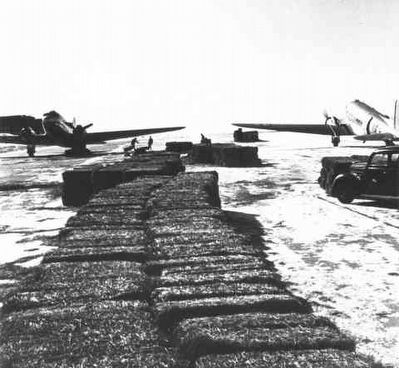
Photo: Casper College Western History Center
Photo: Barry Swackhamer
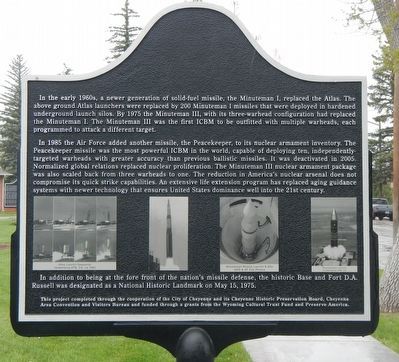
Photo: Barry Swackhamer
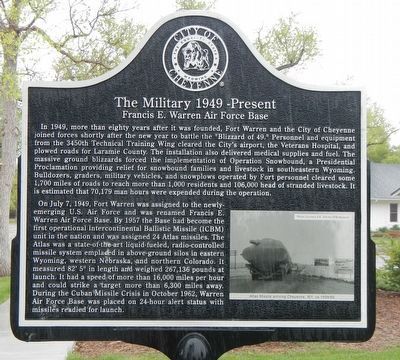
Photo: Barry Swackhamer
FIND IT
Cheyenne, Wyoming · USA
NEARBY MARKERS
© 2026 MainEngine