Military
1
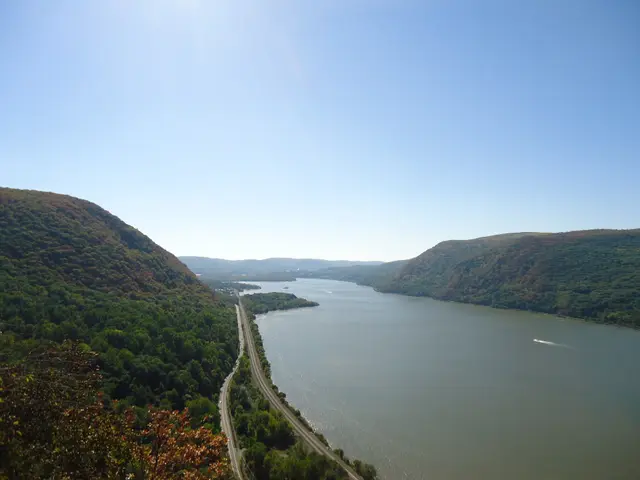
During the American Revolution, the Americans sought to block British ships on the strategically important Hudson River with obstacles supported by forts, cannons, and mortars. Early efforts included chevaux-de-frise between Fort Washington and Fort Lee in 1776, another chevaux-de-frise and iron chain at Fort Montgomery in 1776-1777, and a partially completed barrier at Pollepel Island north of West Point. After the British captured Fort Washington on November 16, 1776, the first barrier became useless. Captain Thomas Machin led construction of a chain and boom from Fort Montgomery to Anthony’s Nose, but the chain broke under tidal stress in November 1776 before being repaired and reset. The British stormed Forts Montgomery and Clinton on October 6, 1777, dismantled the chain, and raided upriver as far as Kingston. Governor George Clinton concluded that obstructing the river was sound strategy, and after recovering from his wounds, Machin began work in 1778 on a stronger Great Chain at West Point, stretched from Constitution Island to West Point and kept there until the end of the war. At West Point, the Hudson’s narrow width, sharp turns, strong current, unfavorable winds, and significant tides made navigation difficult, and the barrier was designed to stop ships as they turned into the east-west channel while artillery on both sides of the river could destroy them. The chain was made at Stirling Iron Works in Warwick, Orange County, from links produced there and at Long Pond Iron Works in Ringwood, New Jersey; each link was two feet long and weighed one hundred and fourteen pounds. Floated downriver on log rafts, the completed chain measured six hundred yards and, with swivels, clevises, and anchors, weighed sixty-five tons. Chain Battery protected the West Point side and Marine Battery protected the Constitution Island side, while log cribs filled with rocks, along with pulleys, rollers, ropes, and anchors, held and adjusted the chain. The chain was removed each winter and reinstalled each spring, and a log boom one hundred yards downstream was added to absorb the impact of any ship attempting to penetrate the barrier. Although Benedict Arnold told the British that a well-loaded ship could break it, the Royal Navy never tried to run the barrier. After the war, most of the chain was melted down, but a section of the original wooden boom recovered in 1855 is displayed at Washington’s Headquarters in Newburgh, New York, and a surviving thirteen-link section of the chain is displayed at West Point.
Hear stories like this as you drive
ExploreHere reads historical markers out loud as you pass them: over 325,000 stories across the US. No account needed.
4.7 · 800+ ratings · Free
FIND IT
Philipstown, New York · United States