Industry
11
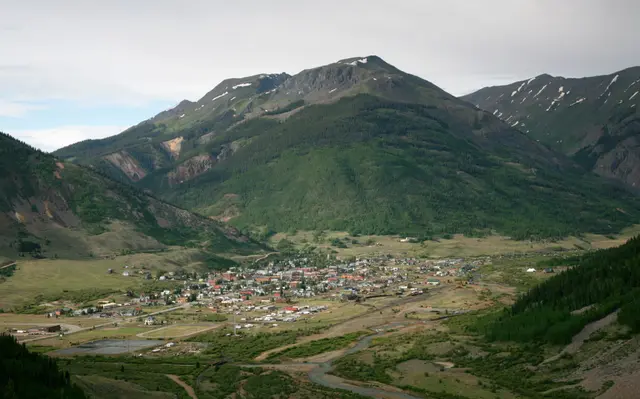
Silverton, Colorado, located at 9,318 feet above sea level, became known as the "Mining Town that Never Quit" and as the Queen City of the San Juan's. Captain Charles Baker led a party into the wide valley in 1860 in search of silver and gold, but the land, owned by the Utes, remained off limits for settlement until the Brunot Treaty was signed in 1874. After that, prospectors by the hundreds poured into these "Shining Mountains." Once the hub of four railroads, Silverton gained the Denver and Rio Grande Railroad in 1882, easing the movement of ore out and goods in. Soon afterward, Otto Mears, called the "Pathfinder of the San Juan's," assembled his "Three Little Railroads," one up each canyon, to bring rich ores down from the high mountains above town. The San Juan's yielded rich ore, and mines at 12,000 feet or higher were worked by miners who lived year-round in boardinghouses that often housed 200 or more men. Because of the steep terrain, elaborate tram systems carried ore down to mills and smelters. Mining in Silverton ceased in 1991, but during its heyday the area produced more than 2 million troy ounces of gold, 51,000,000 ounces of silver, 112 million pounds of copper, 760 million pounds of lead, and 600 million pounds of zinc. Silverton was named a National Historic Landmark in 1962 and is one of only 2,300 in the country.
Hear stories like this as you drive
ExploreHere reads historical markers out loud as you pass them: over 325,000 stories across the US. No account needed.
4.7 · 800+ ratings · Free
FIND IT
Silverton, Colorado · United States