Industry
10
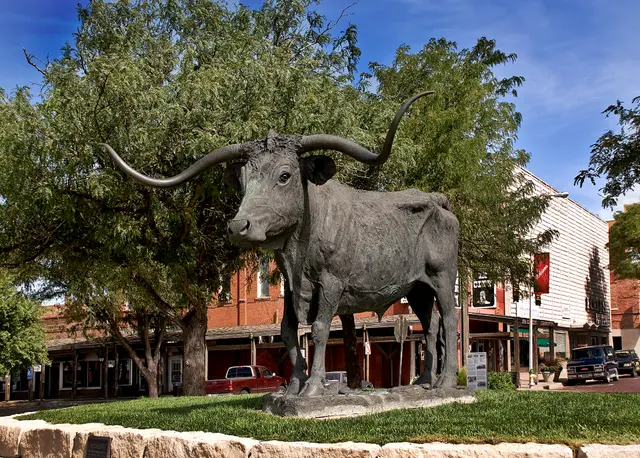
Soon after its founding in 1872, Dodge City became the buffalo-hunting capital of the world, but within three years depleted buffalo herds forced it to find a new source of income, which came from longhorn cattle driven north from post-Civil War Texas to Kansas railheads for shipment to packing houses in the North and East. A steer could be driven from southern Texas to Dodge City for about seventy-five cents, and in herds of several thousand head the longhorns traveled ten to twelve miles a day while grazing on the prairie. Under a trail boss, a dozen or more men worked the cattle for thirty to forty dollars a month during the two-and-one-half- to three-month trip, and many young trail hands received more money at the end of the drive than they had ever seen before. The first herds reached Dodge City in 1875, and in one season arrivals peaked at 500,000 head. Many came by the Western Trail, which ran from southern Texas north to Doan's Crossing on the Red River, then across Indian Territory and into southern Kansas. Dodge City merchants, hotels, restaurants, and railroad agents actively courted the cattle trade, while cowboys finishing weeks on the trail spent their pay in town. During this era, when Dodge City gained the nicknames "Wickedest Little City in America" and "Bibulous Babylon of the Frontier," law officers including Wyatt Earp, Bill Tilghman, Dave Mather, Pat Sughrue, and the Masterson brothers were hired to keep order along Front Street. The same southern Texas longhorns that enriched Dodge City also spread tick fever, splenic fever, or Texas fever, which often killed entire herds of local cattle after a drive passed. The Kansas Legislature eventually created and then extended a quarantine line barring southern Texas cattle from much of the state, pushing cowtowns out of the cattle business, but for nearly ten years the line remained just east of Dodge City, allowing it to continue as the destination of the great southern Texas herds and become the cattle capital of the world. In 1885 the quarantine was extended across all of Kansas, and Dodge City lost its main source of revenue. Although it was later learned that a protozoan carried by cattle ticks caused the disease and that cattle dipping could have killed the ticks, fencing across much of the region made revival of the trails impossible. Even so, Dodge City enjoyed a prosperous, rip-roaring decade as Kansas' best-known cowtown.
Hear stories like this as you drive
ExploreHere reads historical markers out loud as you pass them: over 325,000 stories across the US. No account needed.
4.7 · 800+ ratings · Free
FIND IT
Dodge City, Kansas · United States