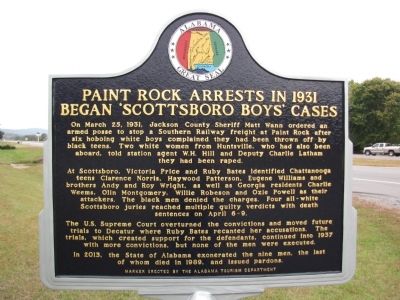
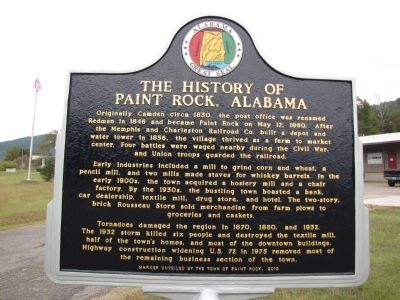
Originally called Camden around 1830, the community's post office was renamed Redman in 1846 and became Paint Rock on May 17, 1860. After the Memphis and Charleston Railroad Co. built a depot and water tower in 1856, the village prospered as a farm-to-market center. Four battles were fought nearby during the Civil War, and Union troops guarded the railroad. Early industries included a mill that ground corn and wheat, a pencil mill, and two mills that made staves for whiskey barrels. In the early 1900s, the town gained a hosiery mill and a chair factory. By the 1930s, it had a bank, car dealership, textile mill, drug store, and hotel, and the two-story brick Rousseau Store sold goods ranging from farm plows to groceries and caskets. Tornadoes struck the region in 1870, 1880, and 1932; the 1932 storm killed six people and destroyed the textile mill, half the town's homes, and most downtown buildings. Highway construction that widened U.S. 72 in 1975 removed most of the remaining business section. On March 25, 1931, Jackson County Sheriff Matt Wann ordered an armed posse to stop a Southern Railway freight train at Paint Rock after six white boys riding the train said black teens had thrown them off. Two white women from Huntsville who had also been aboard told station agent W.H. Hill and Deputy Charlie Latham that they had been raped. At Scottsboro, Victoria Price and Ruby Bates identified Chattanooga teenagers Clarence Norris, Haywood Patterson, Eugene Williams, and brothers Andy and Roy Wright, along with Georgia residents Charlie Weems, Olin Montgomery, Willie Robeson, and Ozie Powell, as their attackers, and the black men denied the charges. Four all-white Scottsboro juries returned multiple guilty verdicts with death sentences on April 6-9. The U.S. Supreme Court overturned the convictions and moved future trials to Decatur, where Ruby Bates recanted her accusations. The trials continued into 1937, drawing support for the defendants and resulting in more convictions, but none of the men were executed. In 2013, Alabama exonerated the nine men, issued pardons, and recognized men whose last survivor had died in 1989.