Transportation
3
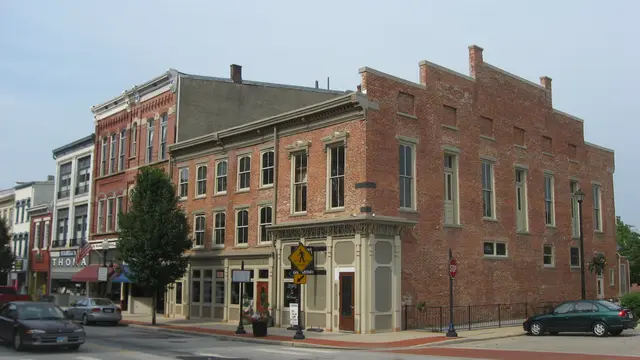
Main Street in Piqua grew from a Native American trail that paralleled the Great Miami River and crossed the river’s east bend, creating the route that became the center of the future city. The trail later formed part of the Detroit Trail, used by General George Rogers Clark in 1782 and General “Mad” Anthony Wayne in 1794 during campaigns against area Native American tribes. At the turn of the nineteenth century, European-Americans began settling the area, and John Manning and Matthew Caldwell chose to found a village rather than farm; in 1807 they hired Armstrong Brandon to survey 101 lots and lay out streets for Washington, later renamed Piqua, with the old north-south Detroit Trail established as Main Street. By 1808-1909, county roads linked Main Street to the Miami Valley, including roads to Troy and Fort Loramie, and another direct road to Fort Loramie met it at the present intersection of Main Street and Riverside Drive. Originally a dirt road plagued by mud, dust, and deep ruts from heavy traffic, it was first maintained by scraping, then by oiling in the 1880's, paved with brick in 1895, and later surfaced with asphalt and cement. During the 1820's and 1830's, shops, taverns, public halls, mills, and the community’s first brick homes lined the street. Piqua’s government took center stage there in 1845 with the first Town Hall facing Main Street, and larger commercial development followed with the 1860 Commercial Block and later major department stores and Second Renaissance Revival buildings, including Benkert's, Maneer-Freeman, Brown's, the Piqua National Bank, the Orr-Flesh Building, and the Buntin-Young Building. The Ohio Theater in 1928 and the Kresge Building in 1932 were the last two major structures completed on the street. Main Street also served as a transportation hub through road travel, nearby canal traffic, and its crossing with the Pennsylvania Railroad, while hosting parades, political rallies, community celebrations, holiday remembrances, and occasional social strife such as a KKK rally, strikes, and civil rights sit-ins. It has continued into the twenty-first century as the heart of Piqua’s central business district.
Hear stories like this as you drive
ExploreHere reads historical markers out loud as you pass them: over 325,000 stories across the US. No account needed.
4.7 · 800+ ratings · Free
FIND IT
Piqua, Ohio · United States