History
4
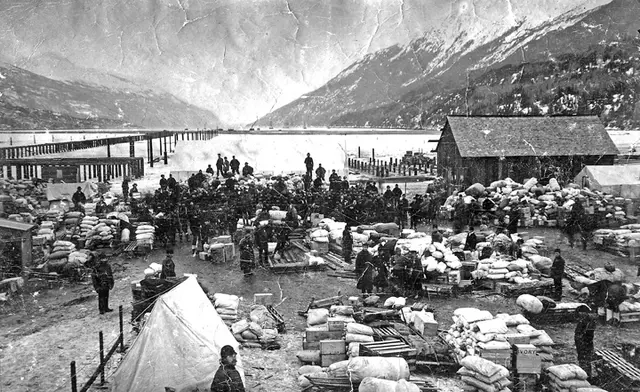
Skagway’s deep-water harbor and its position at the start of the White Pass Trail made it a main gateway for thousands of stampeders heading to the Klondike gold mines. Captain William Moore anticipated the rush and tried to prepare by building a wharf, a sawmill, and other improvements. In July 1897, nearly a year after gold was discovered in the Klondike, ships crowded with people and supplies began filling the harbor as many believed Skagway was the best starting point for the overland journey to the interior gold fields. The sudden influx transformed the wilderness river valley into a fast-growing town of tents, log cabins, rough frame buildings, stores, hotels, restaurants, and businesses. During the fall and winter of 1897-1898, the harbor was crowded with ships, scows, and barges unloading passengers, freight, equipment, supplies, and animals, while Frank Reid, the city surveyor, quickly laid out the new town in 360 lots. Transportation was the greatest need for those bound for the Klondike, and the dangers of White Pass encouraged new ventures such as the Brackett Wagon Road, operating by the winter of 1897-98 with tolls, and the White Pass and Yukon Route Railroad, funded in the spring of 1898 by Close Brothers of England. Skagway’s deep-water waterfront gave it an advantage over nearby Dyea, whose shallow harbor required freight to be lightered ashore, and when the railroad was completed people abandoned the trails. For a century, Skagway and the railroad shared a common history rooted in the waterfront, where generations worked in rail service, longshoring, freight handling, and community services.
Hear stories like this as you drive
ExploreHere reads historical markers out loud as you pass them: over 325,000 stories across the US. No account needed.
4.7 · 800+ ratings · Free
FIND IT
Skagway, Alaska · United States