Transportation
1
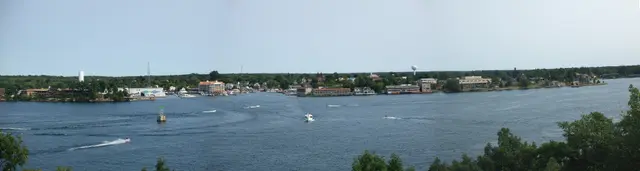
The St. Lawrence River was first explored by Jacques Cartier in 1535, and settlers were discussing canals there as early as 1680 to aid navigation, but the first navigational work began 150 years later and the present Seaway was completed in 1959. The natural waterway formed by the St. Lawrence River, the Great Lakes, and their channels extends more than 2300 miles from the Atlantic Ocean to Duluth, Minnesota, with oceangoing vessels entering at the Gulf of St. Lawrence and traveling 1000 miles inland to Montreal, where the Seaway begins. Between Lake Ontario and Montreal, the water drops 266 feet over 182 miles, and an oceangoing vessel normally navigates the Seaway in 25 hours, passing through seven locks, five operated in Canada by the St. Lawrence Seaway Authority and two by the St. Lawrence Seaway Development Corp. of the United States. Over the past quarter century, this U.S.-Canadian operation ranked as an outstanding example of international cooperation. The largest ships on the Seaway are the Lakers, averaging 620 feet long with cargo capacities of 16,000 tons and reaching 1000 feet and 50,000 tons at the largest, while seagoing Salties average 450 feet long and reach 709 feet at the largest. Through the Seaway's Montreal-Lake Ontario section, total tonnage has averaged more than 55 million tons during the past ten years, and since 1971 the shipping season has averaged 265 days, or nearly nine months, from late March to mid-December. Annual direct income benefits to U.S.-Canadian Great Lakes ports from commerce moving through that section are estimated at more than $1 billion. Across the main channel lies Alexandria Bay, New York, which at the turn of the century was a bustling community of grand hotels and commercial docks where the rich and famous sailed to their islands in Millionaire's Row, and which remains a busy waterfront of cabin cruisers, speed boats, sail boats, fishing boats, and tour boats. Freight traffic on these waters includes ocean bulk freighters carrying bulk cargo such as grain, self-unloaders, tankers for liquids usually oil, ocean general cargo vessels with derricks and booms for package cargoes, and lakes bulk freighters built for coal, grain, or iron ore.
Hear stories like this as you drive
ExploreHere reads historical markers out loud as you pass them: over 325,000 stories across the US. No account needed.
4.7 · 800+ ratings · Free
FIND IT
Alexandria Bay, New York · United States