History
5
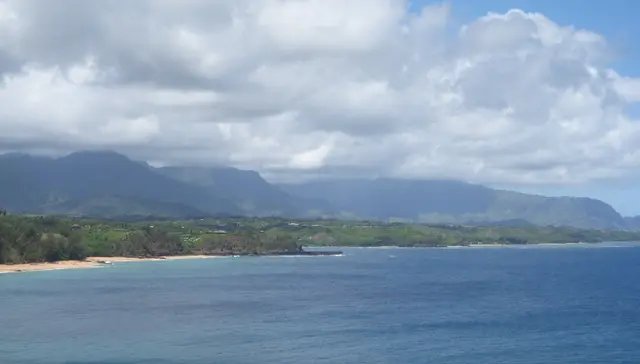
A Russian fort named for Emperor Alexander stood on this plateau above Hanalei Bay for a few months in 1816 and 1817 as part of a brief Russian effort on Kaua'i. Russian interest in the Hawaiian Islands grew after reports of Captain James Cook's 1778–1779 voyages reached the Russian Empire, stirring both scientific curiosity and commercial ambitions tied to the Russian-American Company's fur trade in the Aleutian Islands and Alaska and its need for provisions and a stopover on routes to China. After the Russian-American Company vessel Behring was beached at Waimea Bay on January 31, 1815, and King Kaumualii claimed the ship and its cargo, company manager Alexander Andreievich Baranov sent Georg Anton Schaffer to recover them. Schaffer reached Kaua'i in May 1816, found Kaumualii willing to return the cargo and eager for an alliance with Russia, and over the following months established a Russian presence on the island with plans to use Kaua'i as a base for control of the Hawaiian chain. In September 1816 he began Fort Elizabeth at Waimea Bay and ordered two earthenwork forts at Hanalei, Fort Barclay de Tolly and Fort Alexander, while Kaumualii deeded Hanalei province to him and he renamed it Schafferthal. By spring 1817 Kaumualii had lost confidence in Schaffer, and on May 8, 1817, ordered him and his compatriots off Kaua'i; they fled to Hanalei, where Schaffer intended to make a stand at Fort Alexander before sailing away on June 6, 1817. Fort Elizabeth's remains survive at Waimea Bay, Fort Barclay has disappeared, and Fort Alexander was mapped and excavated in 1973, revealing clay-and-topsoil walls, foundations for only two small structures, a mound marking the fort's perimeter, and two stone foundation remnants. The story of grand ambitions at Hanalei continued when Robert Crichton Wyllie, a Scotsman who became Hawaiian foreign minister in 1845, assembled a large estate and sugar plantation there beginning in 1853, envisioned it as a magnificent manor, and after a royal visit in 1860 named it Princeville for Prince Albert Edward Kauikeaouli Leiopapa a Kamehameha, whom he hoped to make heir; the prince's death in 1862 and Wyllie's own death three years later ended those plans, and although the indebted estate was auctioned in 1867, the name Princeville endured.
Hear stories like this as you drive
ExploreHere reads historical markers out loud as you pass them: over 325,000 stories across the US. No account needed.
4.7 · 800+ ratings · Free
FIND IT
Hanalei, Hawaii · United States