History
2
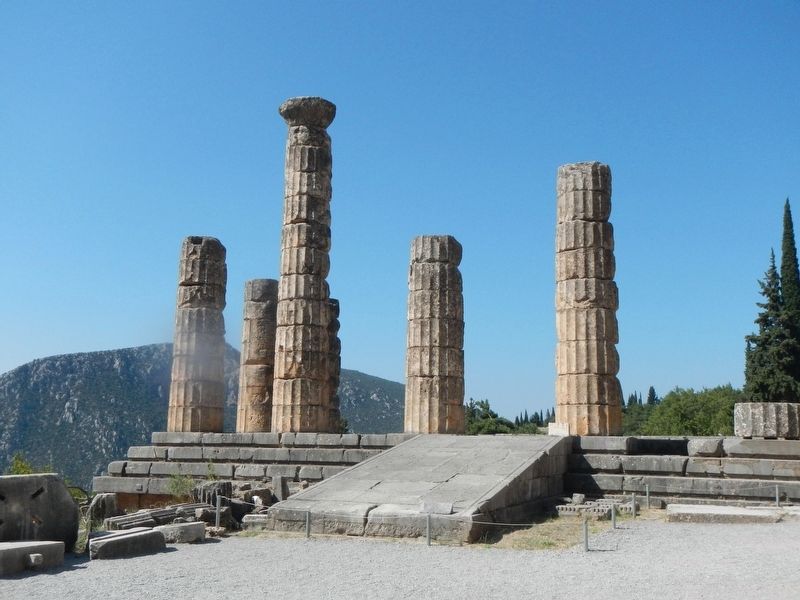
The Temple of Apollo, god of music, harmony and light, stood in the most important and prominent position in the Delphi Sanctuary. The partially restored colonnaded building visible today dates to the 4th century BC and is the third temple built on the same site. According to the prevailing theory, the famous oracle operated inside the temple, possibly because the location was chosen for a sacred chasm emitting vapors that the Pythia inhaled before entering delirium and uttering inarticulate cries that priests turned into equivocal oracles. According to myth, the first temple, dating to the second half of the 7th century BC, had foundations laid by Apollo himself and was completed by the architects Trophonios and Agamedes. The second temple was completed in 514-506 BC with funds from the Athenian family of the Alcmaeonids. Built in the Doric order, it had 6 columns on its narrow sides and 15 on its long sides, was made of porous stone except for a marble facade from Paros, and had sculpted pediments by the Athenian sculptor Antenor. Its east pediment showed Apollo arriving at Delphi in triumph on a four-horse chariot, and its west pediment showed the battle between gods and giants. Strong earthquakes destroyed this temple in 373 BC. The later Temple of Apollo visible today was inaugurated in 330 BC and is attributed to the Corinthian architect Spintharos. Also Doric and surrounded by a colonnade, it was built of coated porous stone, while its roof and pedimental sculptures by the Athenian artists Praxias and Androstenes were made of Parian marble. The east pediment of the 4th century BC temple showed Apollo flanked by Leto, Artemis, and the Muses, while the west pediment showed Dionysos among the Thyiades. Persian shields captured by the Athenians at Marathon in 490 BC and Gallic shields taken after the repulse of the Gauls in 279 BC were attached to the temple's metopes. Ancient writers say the walls of the pronaos bore the famous maxims ΓNΩΘI ΣAYTON, know thyself, and MHΔEN AΓAN, nothing in excess, along with the enigmatic Delphic symbol E.
PHOTOS

Photo: Museum of Delphi

Photo: Barry Swackhamer

Photo: Barry Swackhamer

Photo: Barry Swackhamer

Photo: Barry Swackhamer
FIND IT
NEARBY MARKERS
© 2026 MainEngine