Nature
3
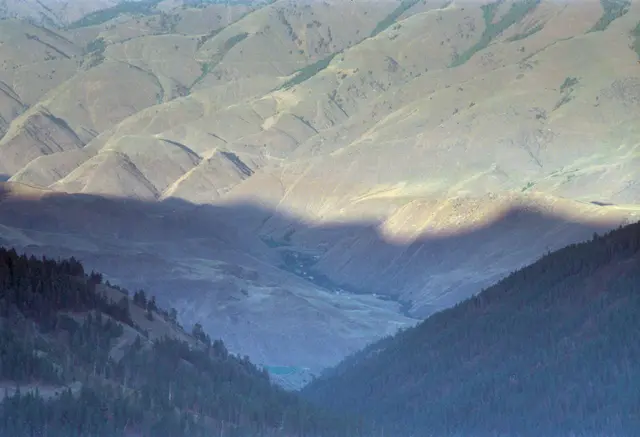
Before recorded history, the area now known as Riggins lay on the west coast of the North American continent while the Pacific Plate, covered by ocean except for a few high points, moved east at about six inches a year. About 100 million years ago, the Pacific Plate collided with the North American continent in the area from Hells Canyon east to French Creek, about 20 miles up the Salmon River, and the resulting heat and pressure changed igneous stone in the impact zone from basalts and granites into metamorphic stone containing pockets of gold, silver, copper, and crystals. This change is visible in greenstone outcrops and large schist boulders with bands of quartz about five miles south of town, and it can be seen north to White Bird and east to French Creek along the Salmon River. The lower Salmon River breaks are grass-covered hillsides dotted with sagebrush, hackberry, serviceberry, and mountain mahogany, with syringa blooming profusely in spring. The most dominant grass is invasive cheatgrass, a non-native grass considered rangeland feed, while livestock and game animals prefer bluebunch wheatgrass and Idaho fescue, which are also abundant on the steep slopes. Surrounding forests contain trees from seedlings to 350-year-old giants, and the climate supports major conifer species including ponderosa pine, Englemann spruce, white bark pine, and yew wood. Wildflowers such as Indian paintbrush, arrow leaf balsam root, lupine, black-eyed Susan, beargrass, and wild rose color the canyon landscape from early spring well into July because of the extreme elevation difference from valley floor to mountain peaks. The mountains and forests around Riggins shelter big game including elk, deer, moose, bear, mountain lion, wild sheep, goats, coyotes, and wolves, along with small game from chipmunks to otter, beaver, and badger. Chukkar partridge, grouse, quail, and wild turkey inhabit the canyon, and spring brings migratory birds such as mountain bluebirds, robin, western tanagers, and swallow, while eagles, hawks, and owls live and feed along the river and forest. Chinook salmon and steelhead run and spawn each year in the Salmon River and smaller streams, rainbow trout, whitefish, and bass thrive in nearby lakes and streams, and prehistoric sturgeon up to ten feet long and more than 100 years old roam the waters of the Snake and lower Salmon rivers. Salmon River Country is a patchwork of land ownership and management, and its lands are managed to enhance recreation, wildlife, timber, clean water, and other resources while remaining fragile and in need of protection for future generations.
Hear stories like this as you drive
ExploreHere reads historical markers out loud as you pass them: over 325,000 stories across the US. No account needed.
4.7 · 800+ ratings · Free
FIND IT
Riggins, Idaho · United States