History
2
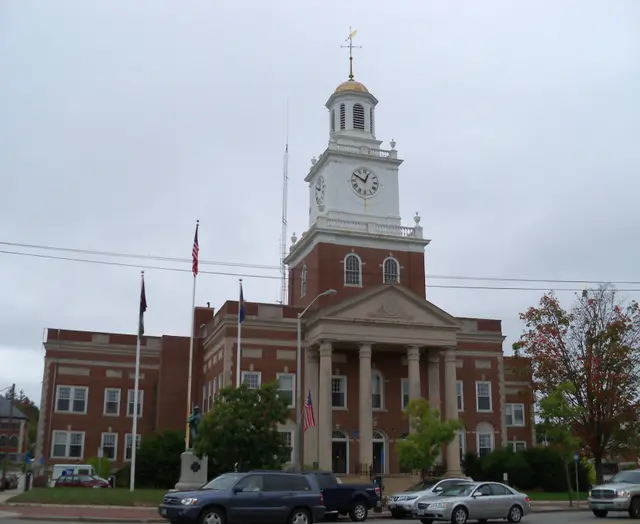
Just after the turn of the 20th century, Central (Lower) Square was a busy business center at the intersection of Central Avenue and Washington Street in Dover. On the right stood the Masonic Temple, which housed Frank J. Hanson’s gentlemen’s clothing store, Charles A. Faxon’s grocery, and many other businesses; it burned on March 29, 1906, and was rebuilt the following year. Dover’s City Hall and Opera House stood on the site of the present-day city hall as the city’s third municipal building, and like the first two it also burned, with the Opera House fire occurring in 1933 before the current Municipal Building replaced it in 1935. At the corner of Hale Street stood the Woodman Block, built in the late 1890s by Theodore Woodman, whose mansard roof made it an outstanding example of Victorian-style commercial architecture; Woodman also donated the land now occupied by the Woodman Park School. Next door stood the Belknap Congregational Church, built in 1859, closed in 1911, and razed in the mid-1960s for a parking lot. Nearby at the corner was J. Herbert Seavey’s Hardware Store, a Dover institution for many decades. Above it was the printing office of Foster's Daily Democrat, founded by Joshua Lane Foster on June 18, 1873; the paper moved there around 1900, expanded many times, began with four-page issues sold for 1.5 cents to 150 readers, and later became the only newspaper in the nation carrying a family name on its masthead and the only daily paper in the U.S. to pass through five generations until its sale at the end of 2014.
Hear stories like this as you drive
ExploreHere reads historical markers out loud as you pass them: over 325,000 stories across the US. No account needed.
4.7 · 800+ ratings · Free
FIND IT
Dover, New Hampshire · United States