
Faith
The Altar of Artemis, also called the Lydian Altar, is the oldest preserved building in the sanctuary of Artemis and was the focus of ritual and ceremony there. It had two main building phases, one older than the temple itself. The earlier structure was a stepped foundation of coarse tufa that now resembles a stepped pyramid, though its rough stone and workmanship suggest the preserved courses were underground foundations and that the destroyed building above may have been more finely made. It may be the oldest structure in the sanctuary, dating to the time when Sardis was ruled by the Achaemenid Persians, perhaps about 500-400 BC, and there is no evidence for a temple in that period, suggesting the Lydians may have worshipped differently from the Greeks and Romans. In a later period, this building was incorporated into a new, larger structure that probably served as a platform for a smaller altar where animal sacrifices, libations, and other offerings were made. Marble stairs across the front led to the higher level; most of these blocks were robbed out in antiquity, though a few survive at the sides. The walls were originally finely stuccoed, with traces still preserved and some protected by modern mortar. Stelai, stone slabs bearing inscriptions, reliefs, or both, were set against the left side of the altar, on either side of the stairs, and in two rows leading up to the temple and altar. A few were found in situ during excavation, and some carried inscriptions in Lydian, reflecting the strong interest of later Sardians in their own ancient history. A distinctive feature of the altar was its closeness to the temple, so close that it was eventually connected to it by walls that are now mostly missing. This reversed the usual temple and altar arrangement of Greek practice: instead of facing away from the temple, the stairs to the altar faced toward it and may in the final phase have formed the temple's main entrance. The altar was restored in 2010-2012, with modern travertine stair blocks replacing the original marble stairs to protect the foundations, and the walls were rebuilt to the condition in which they were found in 1910 and capped with slate.
PHOTOS
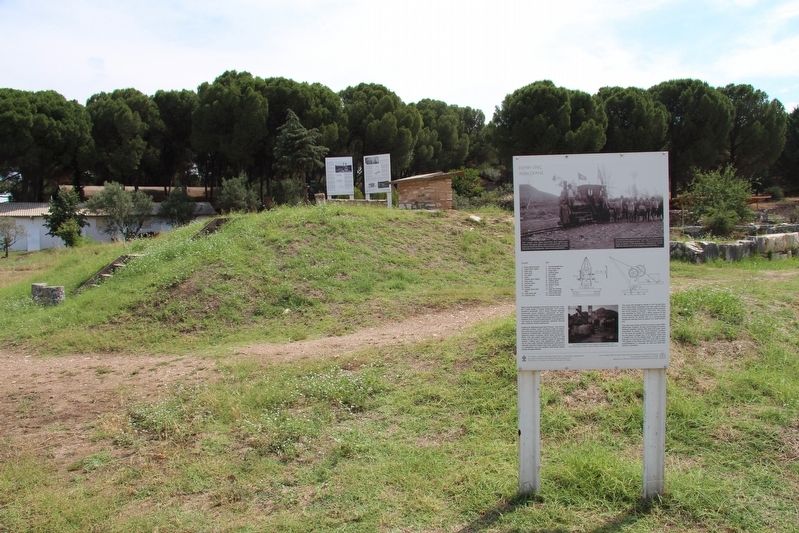
Photo: Dale K. Benington
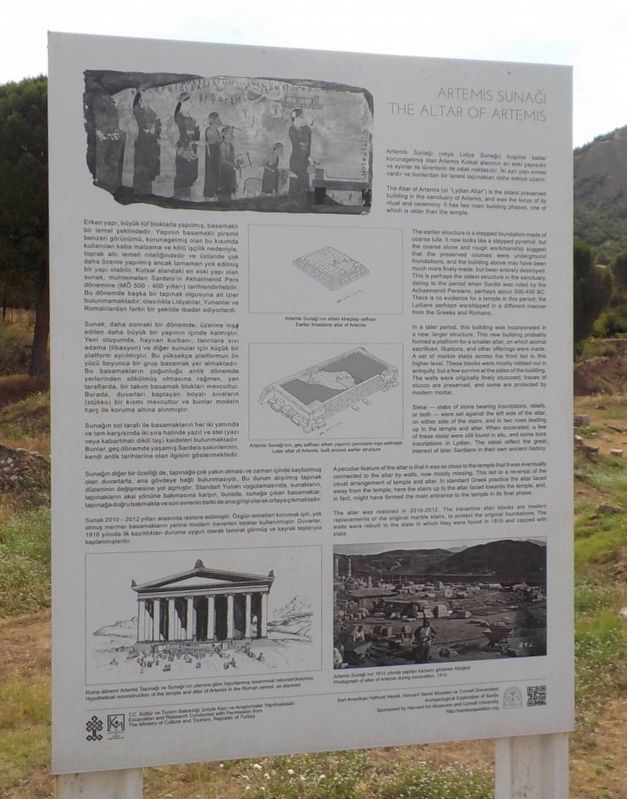
Photo: Pam Benington
FIND IT
NEARBY MARKERS
© 2026 MainEngine